
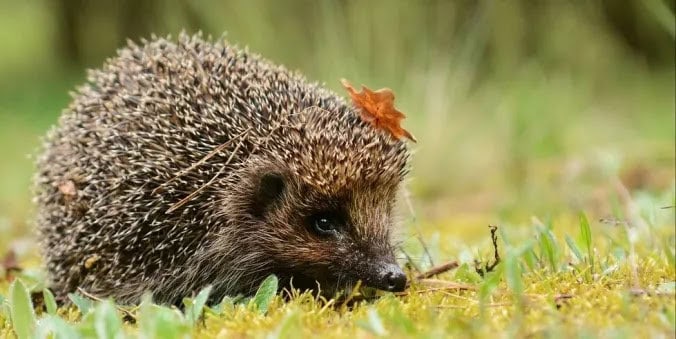
Scientific name: Erinaceus europaeus
Conservation status: Protected in the UK under the Wildlife and Countryside Act, 1981. Priority Species under the UK Post-2010 Biodiversity Framework.
IUCN Red List for British Mammals – vulnerable to extinction.
There are 17 species of Hedgehog worldwide, our familiar garden visitor is the European Hedgehog. They are found across most of Western Europe and are widespread across the UK, although absent from some Scottish Islands.
Originally called Urchins in the Middle Ages, and in fact, giving their name to the Sea Urchin, the young are still sometimes referred to as Urchins, or more commonly Hoglets.
Covered in spines for defence, the average adult Hedgehog can have around 5,000-7,000 quills made of keratin (the same substance as our fingernails). Growing to between 20-30 cm long, many people don’t realise Hedgehogs have 1-2 cm tails hidden among their spines and fur.
Although most commonly Hedgehogs are brown, a large proportion of the hedgehog population on the Channel Island of Alderney are blonde. They have very few predators on the island which means this characteristic which would lead to them standing out and being more susceptible to predation in normal circumstances has not been bred out of the population.
Hedgehogs live in most parts of Britain, the only unsuitable habitats for them being very wet areas and extensive pine forests. Their name was derived from their particular preference for hedgerows which provide protected nesting sites, a good supply of food and corridors to move along. They have become well established in urban and suburban areas taking advantage of cemeteries, railway land and wasteland as well as private gardens.
Hedgehogs reach sexual maturity in their second year of life and after this can breed every year until the end of their life. Hedgehogs have been known to live for seven years, but a lifespan of two to three is more typical.
They reproduce between April and September, but the period of greatest activity, “the rut”, occurs in May and June in Britain. The young become independent quite quickly, leaving the nest at around three to four weeks old to go on foraging trips with their mother. After around ten days of learning to forage the young make their own way.
Hedgehogs are nocturnal and will travel up to 2km a night in search of food and mates, which is why it is so important for urban Hedgehogs to have connected routes through gardens.
Hedgehogs are carnivores, their diet is largely made up of invertebrates, their favourites being worms, beetles, slugs, caterpillars, earwigs and millipedes. However, they will occasionally feed on carrion, frogs, baby rodents, baby birds, birds’ eggs and fallen fruit.
Their invertebrate diets give their droppings the recognisable appearance of being full of crushed-up insects and beetle exoskeletons. The droppings are roughly cylindrical, and sometimes tapered, ranging in length from 15-50mm.
Although Hedgehogs are actually excellent swimmers, they struggle to get out of steep-sided pools or ponds, so if you have water in your garden it is important to ensure there are gently sloping escape routes should a Hedgehog fall in.
The Hedgehog’s spiny defences are very effective against most predators. The Badger being the only creature strong enough to take them on, although Foxes and dogs may pose a threat to young hoglets.
In addition to their spines, Hedgehogs have an additional defence mechanism of “self-anointing”. They are immune to certain species of poisonous plants which they eat and then make a frothy saliva in their mouth containing partially digested plant matter. One theory for this behaviour is that they are masking their scent from predators, and other aggressive hogs during breeding season.
The biggest threat to the Hedgehog is the degradation and segmentation of their habitat, so the more we can make our gardens and allotments Hedgehog friendly, and connected spaces, the better for the Hedgehog’s future.
Find out more about our Hedgehog Highways project here.