
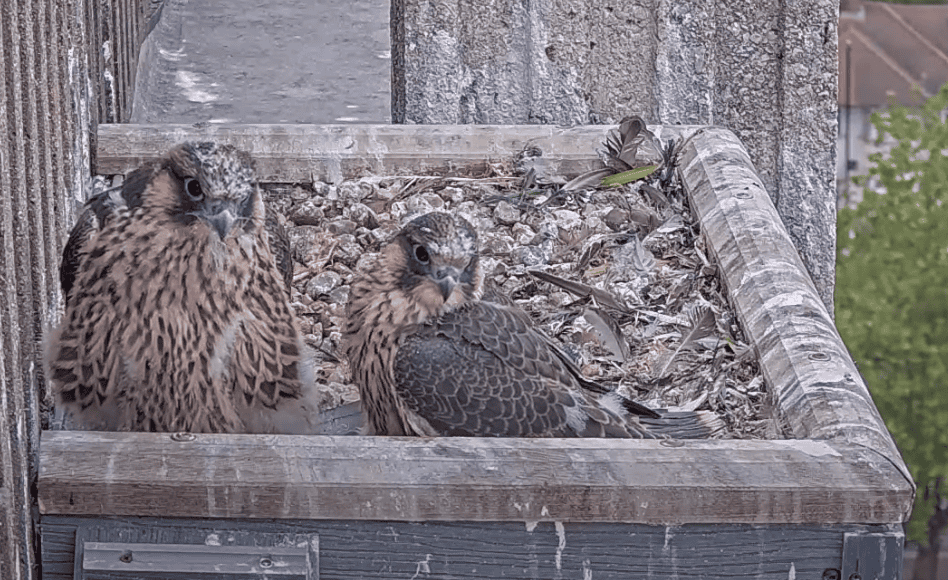
Like me, anyone watching our Peregrine live webcam would have had their hearts in their mouths watching the two young chicks wobbling along the ledge beyond the nest box! Their wandering has been enabled by the ramps on the side of the box, so they can walk the ledge, stretch and exercise their wings. Somehow, they are balancing well, albeit with some considerable wobbles.
I hope you all managed to catch Sean’s video of their ringing on 17 May on Facebook. It’s always a nervous time for the chicks, Dusty, Freddie and the ringing team who have to hang over the edge of Ealing Hospital to reach the chicks and handle them with care.
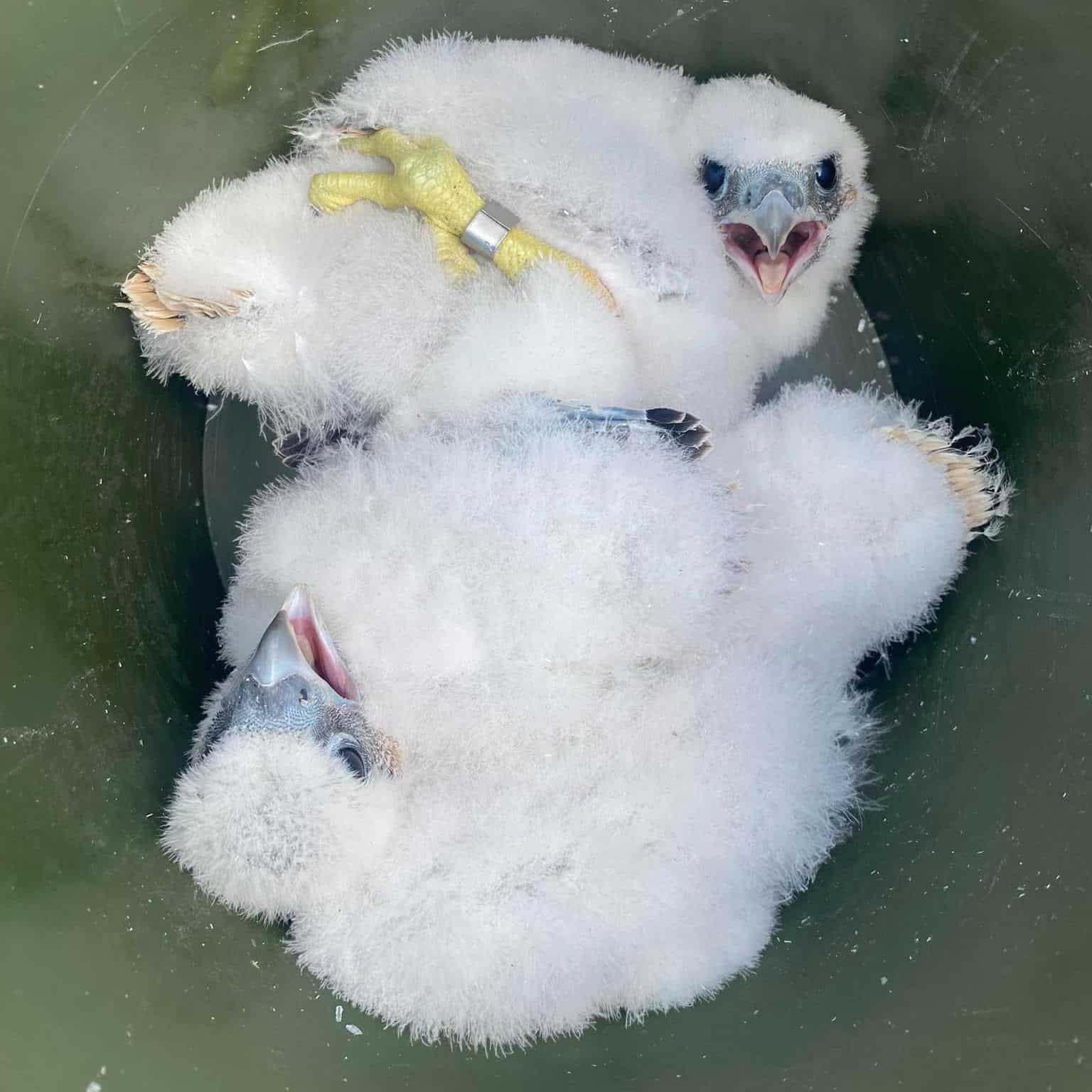
The team of Sean, Caroline, Jamie Passmore (Ealing Ranger) and Phil J Belman (BTO licenced ringer) took just 20 minutes to complete the 2024 ringing. As a Schedule 1 protected species only those with a licence can handle the chicks and ring them. Dusty was particularly vocal during the proceedings and can be heard on the video, although once the job was completed she was back in the nest and Freddie arrived soon after with food.
This year we have a male and female who are easily distinguished by size, the female being the larger. They were ringed twice; one BTO unique lightweight metal ring on one leg, and a second unique alphanumerical colour-coded ring on the other leg, that can be easily read from a distance or with binoculars. The coloured ring allows tracking of movements and population dynamics should they turn up at another nest site in the future. Ring sizes are chosen to suit each species and always remain a comfy fit, not too tight to impact the bird in any way, and not too loose that it can come off over the foot.
While being ringed, DNA samples via buccal (mouth) swabs were collected that will be entered into a database. The database is vital in prosecuting wildlife crime when wild-born birds have been stolen for the falconry trade and mislabelled as captive-bred birds.
It’s a myth that birds will smell human presence from handling chicks, most species don’t have a great sense of smell. Disturbing a nest or leaving it prone to predators by blowing its cover makes most small birds abandon nests. Ringing looks disruptive but is a highly worthwhile process to gather DNA and do a health check, particularly for a species that was on the verge of global extinction.
The unhatched egg was also collected and sent to a lab for analysis by the Predatory Birds Monitoring Scheme (PBMS), looking at pesticide or agrochemical resides that could be accumulating in these raptors at the top of the food chain.
We get asked a lot about why some eggs don’t hatch, and the truth is we don’t know. If infertile or the embryo dies then it’s never going to hatch. If it’s late developing compared to the others, it can chill and die after the other chicks hatch as the parents stop incubating to seek food for the live chicks.
Peregrines are wanderers and it won’t be long before our youngsters leave the nest and Ealing for good. They can wander for several years before they arrive at a territory to breed. The female at Charing Cross Hospital, Azina, was born and ringed in the Netherlands, and a London-born female bred in Edinburgh.
We don’t yet have reports of the Ealing chicks from 2022 or 2023, apart from the 2022 male who sadly died soon after fledging by being caught up in loose pigeon netting not far away. The first “Dusty” to show up at Ealing Hospital in 2020 was ringed P4V at a quarry in Farnham, Surrey. She was ousted in 2021 by the unringed Dusty we have now. P3V (sister to P4V) at the age of six has just turned up at the Kingston University nest having been previously sighted at Morden. She has replaced the resident Kingston female who died recently after sustaining fatal injuries. Amazingly, P4V has become the step-mum to the deceased female’s chicks and is helping to raise all four with the resident male.
I am now eagerly awaiting our Fledgewatch to start. Last year it was an amazing experience! We got to see the youngsters go airborne above the nest and we also had a restless night as one of the chicks decided to fly down above the A&E ambulance ramp and stay there! We were relieved to hear that she made it back to the nest box in the morning, probably after having a good rest to regain her strength.
Watch out for the Fledgewatch events on Facebook and our website, with the first on Friday, 7 June at 19:00, as it won’t be long before our 2024 chicks wander for good.
Emma Chard-Cumming
Past EWG Secretary (a life-long obsessed Peregrine fan)