Whether you’re jetting off to distant lands or keeping it local, I hope you will have some time for quiet enjoyment with a good book. I’m happy to share some personal recommendations for books with a nature/wildlife focus.
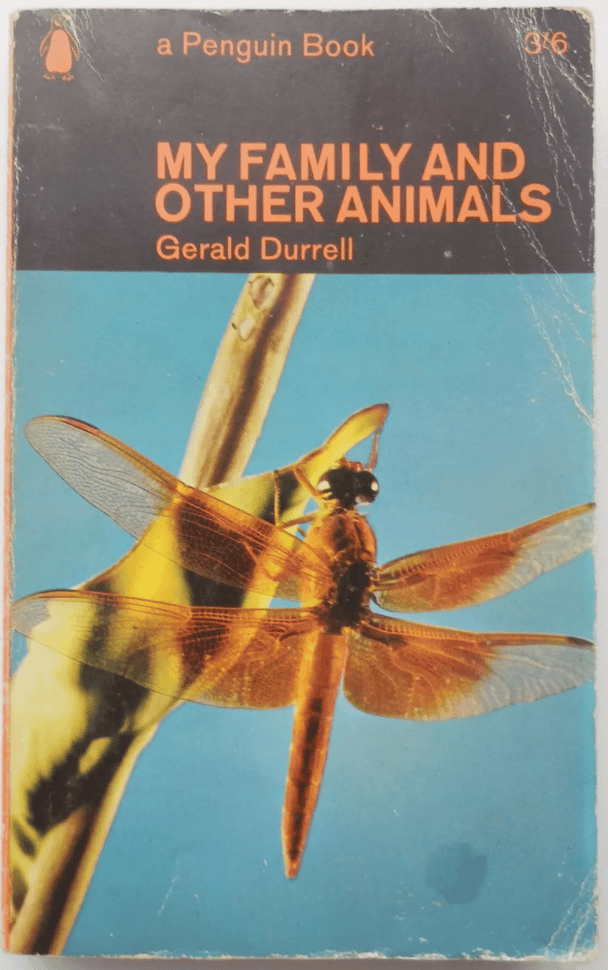
Nostalgia pick: “My Family and Other Animals” by Gerald Durrell.
Maybe you read this as a child, maybe you saw the Netflix series “The Durrells” but whatever your circumstances, unless you’ve read this book in the last month, you should definitely read it again. The book gives a somewhat fictionalised account of five years of the life of the Durrell family, by narrator Gerry, the youngest of the family, together with his sister Margo, brothers Larry and Leslie and his mother.
I read it first at school – the editions provided were heavily bowdlerised, even removing some animal characters completely (notably the puppies Widdle and Puke), but I guiltily read the copy we had at home in its unexpurgated glory.
“My Family” is actually the first part of a trilogy, so if you really have had enough of it, you could try its sequels “Birds, Beasts and Relatives” or “The Garden of Gods”. Otherwise, don’t hesitate to (re-)acquaint yourself with the vividly described family and other animals, including Lugaretzia, the hypochondriac housekeeper, Spiro, the local taxi driver who takes the family under his wing, Geronimo the gecko and his epic battle with praying mantis, Cicely and a host of others. You can marvel at the freedom of an adolescent boy roaming the Corfiot countryside, adopting creatures, such as a female scorpion and her babies, which he traps in a matchbox, with chaotic consequences for the family. When you’ve finished the nostalgia trip, you can move on to the fully biographical account of the family in “The Durrells of Corfu” by Michael Haag which uncovers the tragic reason for the family’s relocation to Greece. Unexpectedly, it also introduces you to Larry’s wife, who is conspicuously absent in “My Family”.
Staycation pick: “London is a Forest” by Paul Wood.
This is an unlikely title, but as home to 8 million trees (roughly one per person) covering 20% of the city, it is well above the 10% minimum cover of the UNFCCC’s definition. This book features six trails, highlighting the trees encountered along the way. Along the trails, the author describes areas of ancient woodland (those existing before 1600), veteran and ancient trees, and some of the more surprising varieties planted in our urban space. For West Londoners, there are two trails – Richmond to Westminster (28km) and Tower Bridge to Heathrow (the longest at 44km).

I was most fascinated by the description of Hackney as an unofficial urban arboretum: the list includes Pagoda trees, a Golden Rain tree, variegated American Sweetgums, the rare Chang’s Sweetgum, and a number of exotic Asian trees, including the intriguingly named Peanut Butter tree. Hackney’s trees are an example of strategic planning – planting a mix of trees makes episodes of mass destruction by disease less likely, such as the catastrophic effect of Dutch Elm disease last century. Additionally, urban conditions are becoming hotter and drier, thus trees from different climates may be a wise pick to ensure the continued benefits of our urban forest.
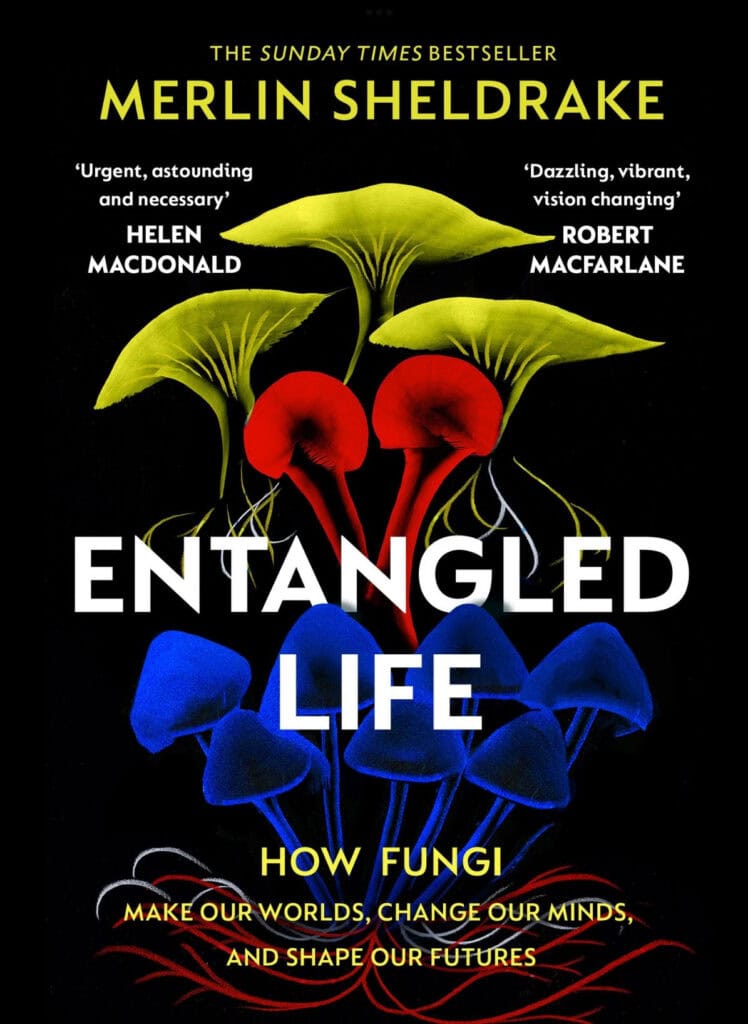
Nerds pick: “Entangled Life” by Merlin Sheldrake.
As a biology undergraduate in my first term, I found myself enduring an interminable series of lectures on mycology (the study of fungi) – dry as a bone, full of stuff I couldn’t possibly need to learn – I didn’t buy the textbook and shunned the topic at exam time. Yes, I was callow youth personified. Fast forward to 2020, on a mundane, lockdown, working-from-home morning, I caught the end of R4’s book of the week. I was entranced by the narrator’s mellifluous tones and the subject matter, mycorrhizal fungi. In a fIash, I knew that I had to find out more.
Of course, I bought the book, and was quickly entangled in the world of fungi. The author (and R4 narrator) is Merlin Sheldrake, a mycologist and writer. Sheldrake became fascinated by symbiosis (close relationships between unrelated organisms), and in particular those between plants and fungi. As a PhD student in Panama, he was enthralled by a jungle flower Voyria, that had lost its ability to photosynthesise (the process by which plants make energy from sunlight, carbon dioxide and water; a quintessentially plant characteristic). Instead, this plant harbours fungi within its roots, and draws the nutrients it requires for life from the fungus. From this starting point, each chapter examines a different aspect of the fungal world, from using psychedelic mushrooms to treat depression to tackling waste, and even to manufacturing. There really is no end of wonder to the members of this overlooked biological kingdom – thank you Merlin Sheldrake for opening up my hitherto biased mind.
This book might be heavy going if you’re not really into science – non-scientist members of my book club did not all share my enthusiasm, but whatever your background, I guarantee that you will be amazed and quite possibly revolted at this peek into the wonderful life of fungi.
What I’ll be Reading: “Taking Flight” by Lev Parikian.
I’ve chosen this for two reasons, the first quite personal. Parikian is a conductor, and as an amateur violinist, I have been conducted by him a number of times; in addition, his father (renowned violinist Manoug Parikian) and mine were colleagues at the Royal Academy of Music for many years. He’s written several books, but this is his latest, and has received the greatest recognition, having been shortlisted for the Royal Society’s Science book prize in 2023.
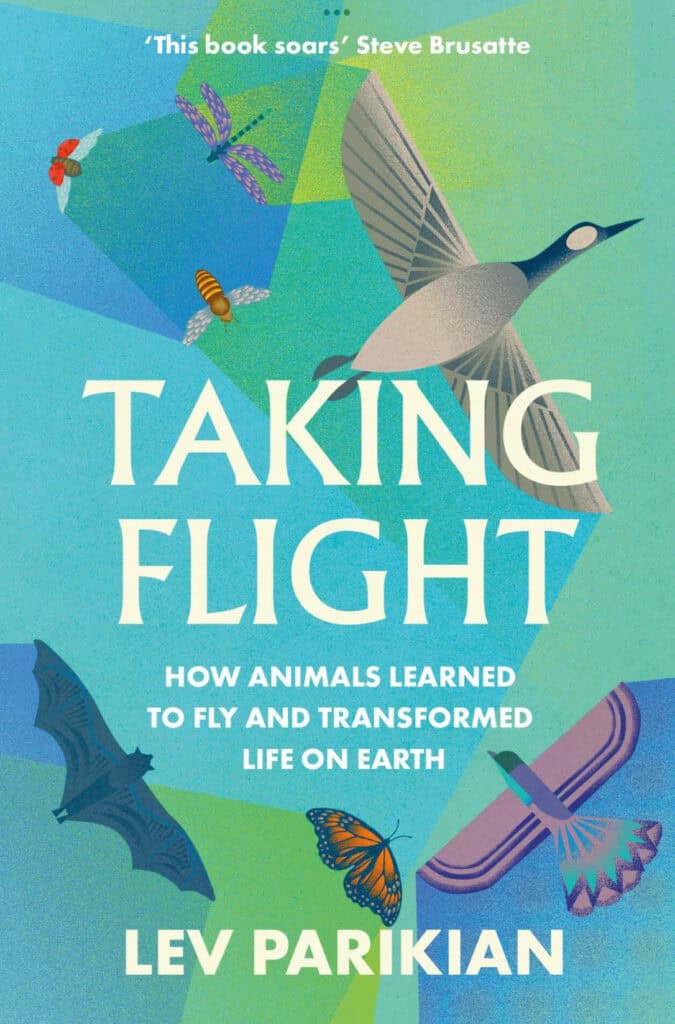
According to various sources, the book is a history of flight, from its first appearance 300 million years ago. In the introduction, the author draws attention to the commonplace and extraordinary nature of flight – a gift that the majority of species possess and that humans so evidently lack. The book is arranged in 14 chapters, each considering a different animal from each of the four evolutions of flight: insects, pterosaurs, birds and bats. Described by one critic as ‘witty, unique and easy to digest’, I’m really looking forward to reading this.
Emily Gardner
EWG Newsletter Editor