
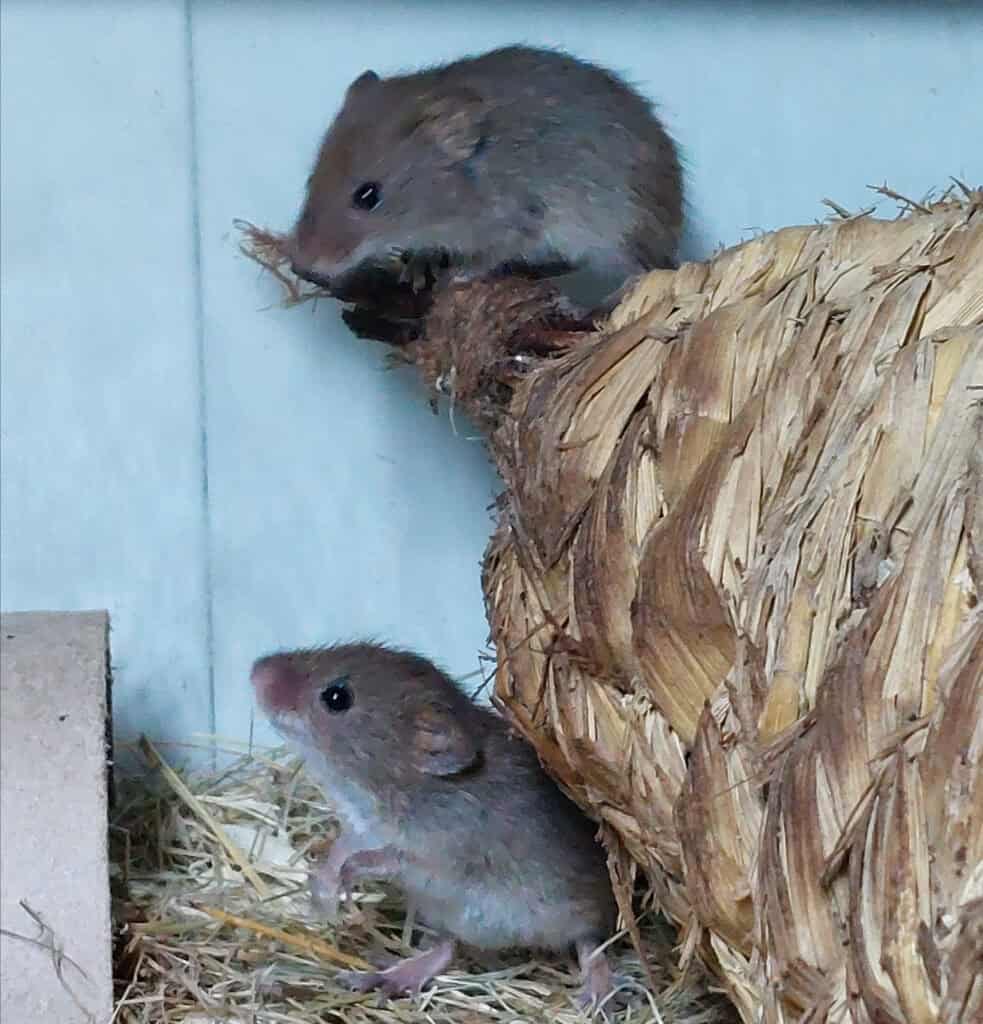
If you have visited Horsenden recently, you may have noticed the beautiful wooden display house between the sensory garden and the farmhouse. Take a moment to peer through the glass, and hopefully spot a tiny little creature dashing around the tank, hurtling up a branch or nibbling a seed. If so, you’ll have seen our Harvest Mice (Micromys minutus) – but why are they there, and what are we doing with them?
![Horsenden Harvest Mice [Photo credit Claire Morris]](https://cdn.shortpixel.ai/spai/q_lossy+ret_img+to_auto/ealingwildlifegroup.com/wp-content/uploads/2024/12/unnamed-37-1024x576.jpg)
Harvest Mice are Britain’s tiniest rodent – and they’re really tiny. Significantly smaller than a House Mouse, they weigh only a few grams – about the same weight as one ripe Blackberry. Due to human farming and building practices eradicating their habitat, they had become locally extinct here in Ealing, with the last mouse recorded here in Perivale Wood in 1979.
![Ecolab babies with egg box for scale [Photo credit Claire Morris]](https://cdn.shortpixel.ai/spai/q_lossy+ret_img+to_auto/ealingwildlifegroup.com/wp-content/uploads/2024/12/unnamed-38-1024x516.jpg)
In 2020, Ealing Wildlife Group launched a rewilding project to return these mice to Ealing, as part of the National Biodiversity Action Plan and supported by Rewild London Fund/London Wildlife Trust.
We have since released almost 2,000 captive-bred mice into sites in Ealing selected for their suitability for Harvest Mouse habitat, from Marnham Fields and Smiths Farm to Horsenden Meadows and Paradise Fields, which they share with their much larger cousins – the family of Beavers released there last year as part of the same rewilding initiative.
Breeding the mice and preparing them for release takes a lot of time and attention, and they are carefully tended by a small team of Horsenden Mousewives (plus one Mouse Husband)! We operate a rota, leaving careful records from each visit so the next Mousewife to visit can check for updates or issues.
Besides the mice in the display house, we look after up to thirty tanks of mice (during baby booms!) in our new Ecolab, which is equipped with such luxuries as electricity and a table – all much appreciated after struggling through long winters caring for the mice in the cold, dark and rat-infested original mouse house!
Entering the Ecolab and the display house at the start of each shift there’s often a palpable energy in the room. The mice are more active at dawn and dusk, so we have seen them at times when the tanks are all suspiciously quiet, and also when every tank seems to be pinging with mice! When they’re active they’re really active, sprinting around the tanks, diving in and out of holes they’ve made in their temporary territories, climbing and scrambling up anything possible. Some tanks have hamster wheels for the mice to release their pent-up energy, and we’re glad to have newly donated plastic wheels to replace the old squeaky metal ones (which must have annoyed those in the neighbouring tanks…).
![Ecolab [Photo credit Claire Morris]](https://cdn.shortpixel.ai/spai/q_lossy+ret_img+to_auto/ealingwildlifegroup.com/wp-content/uploads/2024/12/unnamed-39-576x1024.jpg)
The mice are paired or grouped in different tanks, with a system of stickers and labels to keep track of which animals are in each tank. We don’t name them, but we frequently need to sort them – we create new breeding pairs by matching mice from different genetic strains, periodically adding in new mice from our partner zoos in Calderglen, the New Forest and Battersea – then only a few weeks after birth we need to sex and separate the babies, either to make new pairs or single-sex groups.
Each time we check the mice we top up their food and water. Harvest mice are omnivores, and in the wild will enjoy a varied diet of grasses, seeds, berries and occasional insects, so we try to replicate this in captivity. Mealworms are a particular favourite and provide a good protein source for strengthening the acrobatic little mice.
![Mice in the display house [Photo credit Claire Morris]](https://cdn.shortpixel.ai/spai/q_lossy+ret_img+to_auto/ealingwildlifegroup.com/wp-content/uploads/2024/12/unnamed-40-631x1024.jpg)
We try to replicate their habitat as closely as possible by providing twigs, fresh grasses and cut stems of nettles, brambles, willow, Cow Parsley and other local plants when seasonally available, which provide both food and activity, as they are instinctive climbers (they are the only British mammal with a prehensile tail, which enables them to climb rapidly and gracefully) and very light (able to balance on a leaf without it bending under their weight) The mice are very stimulated by these additions and have usually scurried out to investigate before we can even close the tank! The addition of this enriching greenery also gives a wonderful opportunity for the public to see the mice show off their climbing skills in the display house.
It does make the feeding routine for the next Mousewife trickier though, as they will use the sticks to climb to the top of their tanks and leap out when opened. Temporary escapes are frequent, so we’ve all got cunning at safely catching them again, and each has our own favoured method!
The mice also seem to appreciate the cardboard rolls and egg boxes we put in for hiding and exploring – hopefully, all the stimulation keeps them from picking fights with each other as they can be surprisingly fierce!
The mice make their tanks very messy, but whilst we provide our Mousekeeping room service each week, we try to intervene as little as possible as this is how they will live once released. It’s especially important not to disturb pregnant or nursing mice, so we give them privacy until the joyful moment when we first see the newly furred babies (and they really are impossibly tiny – see picture) leave the nest and start exploring the tank or eating alongside their mother. Their nests are gorgeous works of art, woven by mouse teeth and movement from fresh grass (living grass when available in the wild) to create a snug and secure little nursery.
Whilst topping up food and water, we keep an eye out for any mice who may look ill or injured, signs of a new pregnancy or a new litter of babies, whilst being very careful not to disturb them. We pride ourselves on keeping our mice happy and healthy whilst in captivity.
Harvest Mice in the wild breed in summer, but ours are so pampered they breed prolifically all year round!
Many of the releases are public events, so please keep an eye on the EWG events pages and join us if you would like the amazing privilege of introducing a tiny mouse to its new home. We place each gently into a dense patch of vegetation and tell them to “make good choices” since we know that part of their role in the ecosystem we are supporting is to provide sustenance for Ealing’s growing population of owls and Kestrels. Some mice pause nervously on the hand, unsure what to do, some ping into the bushes before you can even notice they are on your hand, and some climb gracefully into their new habitat and start to explore right before our eyes.
And if you can’t make a mouse release, do take a moment to observe the mice in the display tank – their acrobatics are endlessly fascinating to watch, and yes – I made it this far without mentioning that they are exceptionally cute.
Claire Morris
Horsenden Mousewife
With the project now in its fourth year, funds need to be topped up for the project to continue for the next two years. You can help by sponsoring an Ealing Harvest Mice for £10.00 or as much as you can afford here on the Harvest Mice GoFundMe page.
Harvest Mice GoFundMe Page