
In late May a small group of us braved the bank holiday weather to seek an answer to the question on everybody’s lips…
What happens when you shine an ultra-violet light on a caterpillar?

For those of you who haven’t been wondering this, I need to go back to summer 2023 to explain how we got to this point. Whilst recording species in Paradise Fields before the arrival of the Beavers, I spotted a butterfly which I didn’t recognise. It turned out to be a Brown Hairstreak (Thecla betulae), a priority species for conservation with its own UK Biodiversity Action Plan. Although they were known at Horsenden Hill, this was the first time they had been recorded at Paradise Fields.

Having seen them there, we wanted to find out if they were just passing through the site or if they were breeding as well. In February 2024, a crack team was assembled to hunt for the eggs, which are laid on Blackthorn (Prunus spinosa). Although the eggs are very tiny, this is considered one of the best ways to survey for Brown Hairstreaks, as the adults can be extremely elusive. The hunt was a resounding success, with 60 eggs being recorded over 3 separate areas.

This was a fantastic result and great news for the butterfly. And it got us wondering – could we find the caterpillars later in the year? The trouble was, only around 1 in 200 caterpillars make it to maturity so we would be dealing with a much smaller population than the eggs. On top of this, they only come out to feed at night, and they are a green caterpillar on a green leaf, so spotting them is a challenge, to say the least…
Our tireless Volunteers’ Officer, Fiona McIntyre, came up with the answer. It turns out the caterpillars fluoresce under UV light (quite who found this out and what they were up to at the time was a source of some debate on the night). Equipped with a new UV torch we met at McDonald’s next to Paradise Fields in the late evening to form a plan. As it turns out, McDonald’s is the place to be seen in Greenford on a Sunday night so, realising that (a) we could barely hear each other over the music, and (b) we were raising the average age of the clientele by around two decades, we decided that we would decamp straight to the viewing platform in Paradise Fields.
It’s amazing how abruptly you enter a different world once you get through the underpass. We were a bit early, so we got to wait on the platform as dusk fell, surrounded by columns of dancing midges (fortunately the non-biting variety!) that quickly tempted out the bats. Claire had brought along a bat detector, so we were able to confirm both Common (Pipistrellus pipistrellus) and Soprano Pipistrelles (Pipistrellus pygmaeus) out hunting. They started out hawking along the tree lines, but as it got darker, they came out into the open and we had several swooping directly over our heads.
Once it got properly dark, we headed off to start the great caterpillar hunt. With a bit of trial and error, we managed to work out the best way to use the UV torch and started to pick up a few items fluorescing in the undergrowth, including some insect eggs. The first site didn’t yield any Brown Hairstreak caterpillars, which was a bit of a worry. We moved on to the second site and discovered a new problem. Some of the grasses on the site also fluoresced under UV light! They really did look beautiful but made for an extra challenge when trying to pick out a fluorescing caterpillar.

A few minutes later, we spotted a small shiny creature halfway up a shrub. Some careful examination by our butterfly experts (Claire and Juliet) confirmed success – we had a Brown Hairstreak! After a bit of faffing with my camera (I still tend to glaze over a bit when I try to remember about ISO and f-stop settings) and some proper expert advice from Caroline, I managed to get some photographic records too. Once we got the balance of torch and UV light right, we ended up with some incredible images. The larvae look quite amazing to begin with and under UV light they began to resemble something you might expect to see in the deep sea.
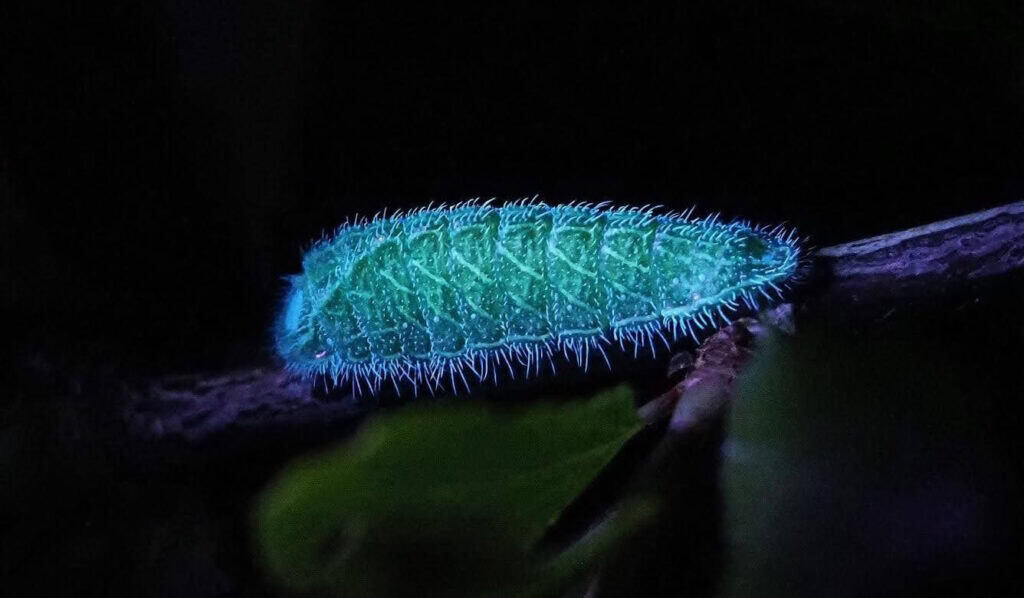

Two of the fluroescent caterpillars we spotted (Photo credits: Alex Worsey and Fiona McIntyre)
The third site was also productive and in total we recorded seven Brown Hairstreak caterpillars, as well as a Lacewing and something we think might have been a Blue-bordered Carpet Moth caterpillar (Plemyria rubiginata). This is a really good result for the site and great evidence that Brown Hairstreaks are thriving here.
You might not be as keen to geek out on caterpillars and eggs as we are but keep an eye out for the adult butterflies soon. They will be on the wing from July to September and we’d love to hear if you spot them around the borough! Also, if you like the idea of becoming involved with more biodiversity surveys contact us at hello@ealingwildlifegroup.com.
Alex WorseyEWG Biodiversity Data Officer
(Header photo credit: Fiona McIntyre)