There is frequent chatter on EWG social media about species that have been introduced to Great Britain, often linked with the adjectives non-native and invasive. Non-native species (NNS) are those that humans have introduced since the end of the last ice age (c. 10,000 years ago) which is some 5,000 years before the start of recorded history (c. 3,000 BCE). It’s estimated that there are around 2,000 established NNS species in Britain (breeding in the wild). Shockingly, this is more than half of our total number of plant and animal species.

With so many NNS inhabiting our isles, it’s clear that most do not cause problems. Many are regarded with much affection, for example, Little Owls (Athene noctua) and the Horse Chestnut tree (Aesulus hippocastanum), and may even be the subjects of conservation efforts, such as the Brown Hare (Lepus europaeus). Others underpin our economy, with the majority of agricultural species (cereal crops and livestock) being NNS.
Around 10-15% of NNS earn the label ‘invasive’ (INNS) due to their range of deleterious effects; they are a major driver of biodiversity loss across the globe. Impacts on native species include:
- Transmission of disease, e.g. Grey Squirrels (Sciurus carolinensis) transmission of Squirrel Pox (SQPV) to Red Squirrels (Sciurus vulgaris)
- Competition with native species, e.g. Harlequin Ladybirds (Harmonia axyridis) are voracious predators, out-competing native ladybirds for food
- Predation on native species – again, Harlequin Ladybirds will eat other ladybird species’ eggs and larvae.
- Hybridisation with native species, for instance, Spanish bluebells (Hyacinthoides hispanica) readily hybridise with native bluebells (Hyacinthoides non-scripta), and also outcompete them for light and space due to their more vigorous growth.
The negative effects of INNS also impact humans, including:
- Increased flooding risk and infrastructure damage, with a huge cost to the economy, e.g. Water Pennywort (Hydrocotyle ranunculoides) and Japanese Knotweed (Reynoutria japonica)
- Health risks, e.g. Giant Hogweed (Heracleum mantegazzianum) which can cause blistering and scarring.
For these reasons, INNS are a focus for the government, with a formal strategy in place to control their spread, managed by the NNS Secretariat.
The borough of Ealing faces challenges from INNS through plants and animals on water and land. Here are just a few examples that are locally relevant:
Signal Crayfish (Pacifastacus leniusculus): These have been the subject of a number of EWG posts on Facebook. They originate from North America and were intentionally introduced as a farmed foodstuff in 1976. They escaped through water courses and across land, spreading across the UK. In the borough, they are present in large numbers in the Grand Union Canal.
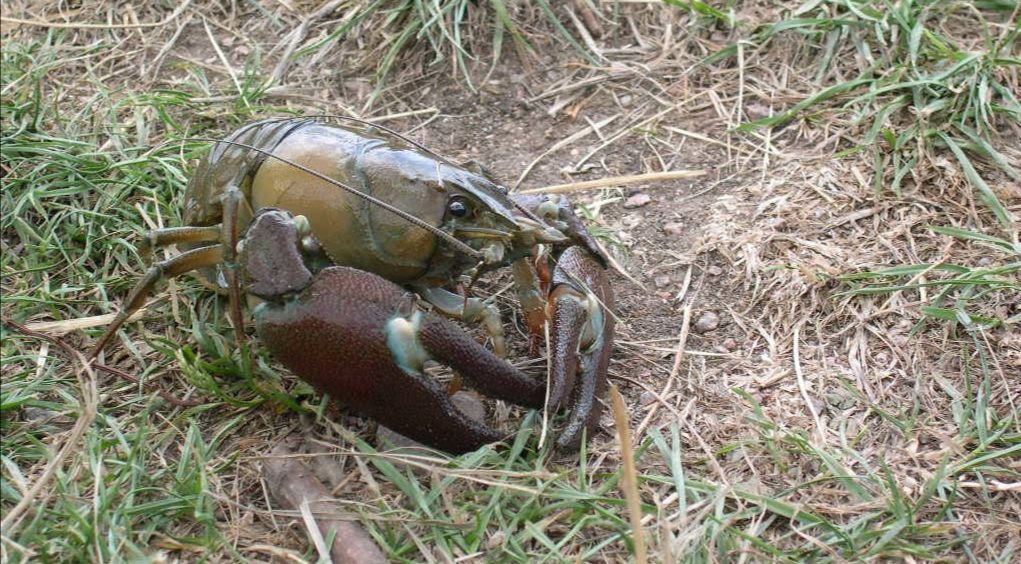
They spread crayfish plague (caused by the fungus Aphanomyces astaci) and compete for resources, driving the native White-Clawed Crayfish (Austropotamobius pallipes) towards extinction. In addition, there are economic consequences. Their habit of burrowing to shelter in riverbanks causes erosion and weakness, which can lead to flooding and danger to livestock and structures built on banks. Unfortunately, control of signal crayfish is not easy. Trapping and removal is ineffective. The best method of control is to prevent further spread by following ‘Check Clean and Dry’ guidance for all clothing and equipment after visiting a watercourse.
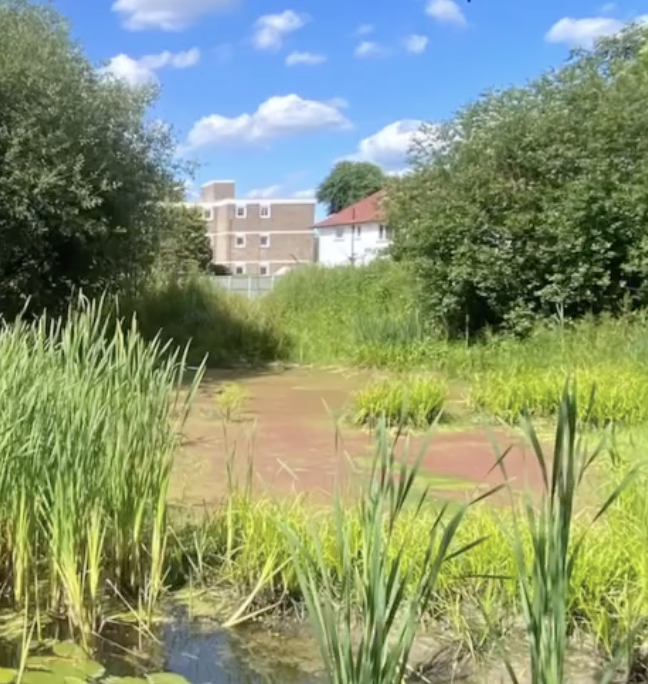
Water Fern (Azolla filiculoides): this is another North American native which was first introduced to the UK at the end of the nineteenth century. Its escape route from botanical gardens to colonise water courses is not known, however the plant can be transported on machinery and boats and possibly wildfowl and contaminated clothing. Locally, it affects the pond at EWG’s Costons nature reserve and also the Litten Nature Reserve in Greenford.
These dense mats can also obstruct water-borne transport and flood defences. Water fern will cover the entire surface of ponds with a carpet of growth up to 30cm thick. This blocks light, killing other aquatic plants and fish. The plant can propagate from fragments, meaning that control by removal is not possible. Happily, there is a form of biological control provided by a weevil (Stenopelmus rufinasus) which feeds exclusively on Azolla. These weevils have been released at Costons, and we are all hoping that they bring the infestation under control
Reeve’s Muntjac (Muntiacus reevesi): These small deer are native to China and Taiwan. They were first released into the wild at the end of the nineteenth century. With no natural predators, the population has boomed since then, and Muntjac can now be found throughout England and Wales, with a small population in Scotland.

Their grazing habits cause substantial damage to woodlands, with knock-on consequences for a wide range of plant and animal species, and they may also displace native Roe Deer (Capreolus capreolus). The only current method of control is culling. An alternative solution would be re-introduction of an apex predator, such as Lynx (Lynx lynx), which became extinct in Britain around 1,300 years ago.
There are several actions that we can all take to reduce the impact of INNS:
- Remember to Check Clean and Dry after using any equipment or clothing in water courses.
- Be Plant Wise and do not let your garden, pond, or aquarium plants enter the wild.Never release pets, or allow them to escape into the wild. It is cruel and could harm other wildlife.
- Record your sightings of invasive non-native species, particularly Asian hornet and other alert species.Continue to support EWG’s work, which aims to protect habitats and improve local biodiversity, leading to overall benefits to the urban ecosystem.
Emily Gardner
Newsletter Editor