
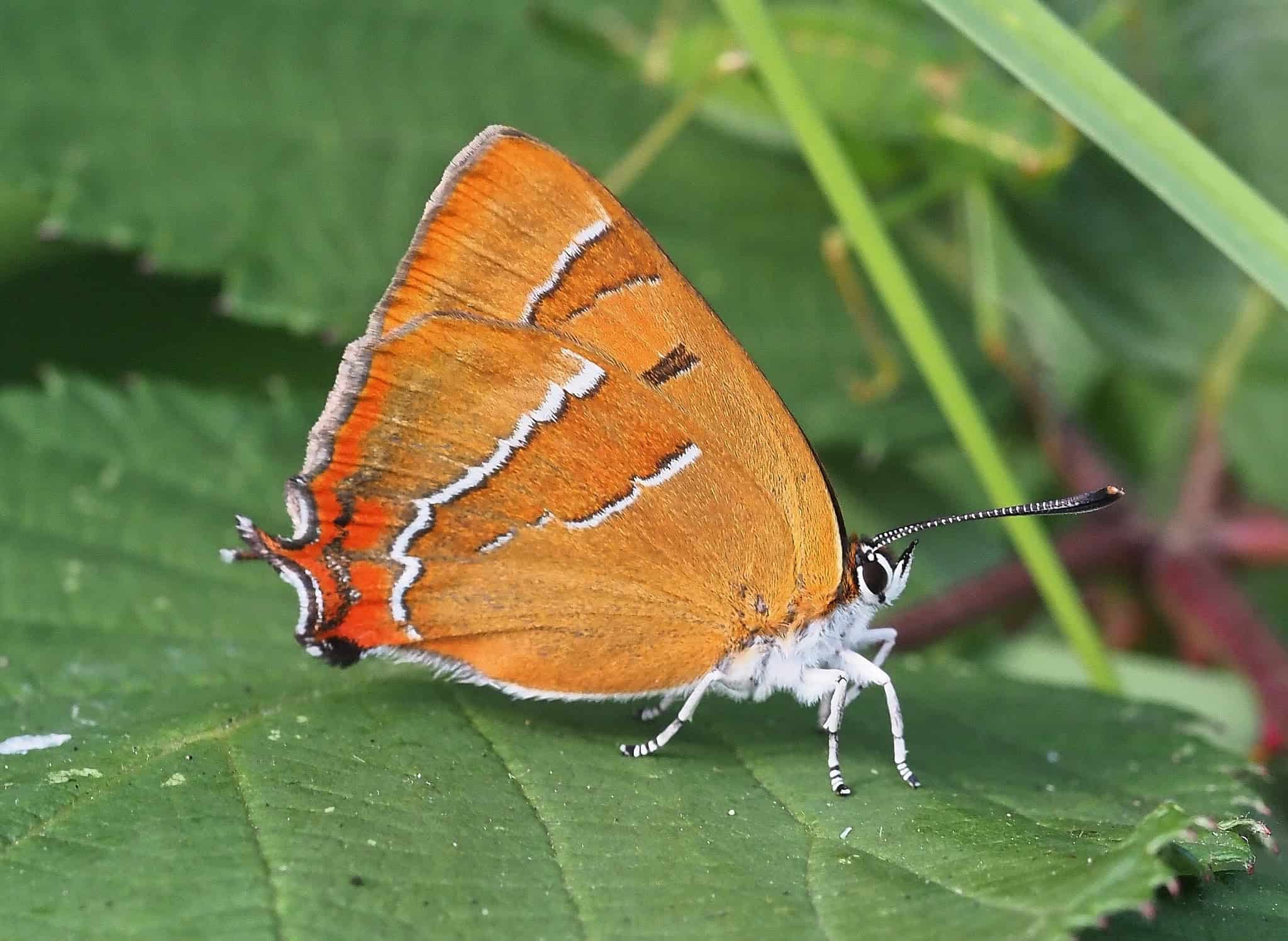
There was great excitement in 2023 when a Brown Hairstreak butterfly (Thecla belulae) was spotted at Paradise Fields. The butterfly is hard to spot, and the males like to hang out high up in Ash trees when they are ready to breed, so this was a real find.
The conservation status of the Brown Hairstreak in London is of concern due to habitat loss and fragmentation. The species relies on specific native plants for breeding, including the Blackthorn that is found in hedgerows and woodland edges – these habitats are increasingly under pressure from development.
But there is real hope as more Brown Hairstreaks are being spotted, including at Horsenden Hill and Perivale Park.
Someone suggested a survey in early 2024 to see how they were faring in Paradise Fields and to identify if they were returning to breed. We needed to do the survey quite quickly before the Blackthorn, one of the butterfly’s favourite spots for laying eggs, started to bloom.
Planning
I knew very little about surveying butterflies, but with the help of Alex Worsey (EWG Biodiversity Data Officer) and a very keen team of butterfly egg hunters, we managed to get a date in the diary. The team included two butterfly lovers – Juliet and Claire – who had surveyed for Brown Hairstreak before and knew exactly what they were looking for – a small, coral-like egg in the fork of a branch.
I knew very little about surveying butterflies, but with the help of Alex Worsey (EWG Biodiversity Data Officer) and a very keen team of butterfly egg hunters, we managed to get a date in the diary. The team included two butterfly lovers – Juliet and Claire – who had surveyed for Brown Hairstreak before and knew exactly what they were looking for – a small, coral-like egg in the fork of a branch.

I spent the week before the event revising some key points (including being able to identify Blackthorn!) and looking at information from other surveys, as well as chatting through the best approach with Juliet.
I spent the week before the event revising some key points (including being able to identify Blackthorn!) and looking at information from other surveys, as well as chatting through the best approach with Juliet.
On the big day
There was a team of six of us on the day, all complementing each other really well. We had two Heads of Identification (Juliet and Claire, who could spot the eggs extremely well), a Head of Data (me, recording the location and number of eggs), a Head of Photography (Victoria), and two other butterfly lovers (Barbora and Mala) busily hunting. By the end of the day, everyone had become skilled at egg spotting.
It was a perfect day, after the threat of rain and sun (neither ideal for surveying) we had the best day for surveying – cloudy!
It was great fun working with the team to devise a system to identify and record the eggs. Once we had found our first egg, we felt a little more confident. There were squeals of excitement each time we located an egg, generally laid on new growth, and the eggs kept on coming! We were careful to differentiate between the Brown Hairstreak eggs and the more oval-shaped Blue-bordered Carpet Moth (Plemyria rubiginata). The eggs are normally laid as one per location, but we saw up to 3 on some branch forks. Some eggs were closer to the ground than we expected.

The results are in…
A googly-eyed two hours after the start of the survey, we found 61 eggs over 3 sites. We could not have been more happy. A real team effort, this provided a good indicator that the Brown Hairstreak is in residence.
Our data has been shared with Butterfly Conservation to help their efforts, and we eagerly anticipate going on an expedition to spot the butterflies from July through to September. Having said that, the adults can be quite difficult to spot!

Thanks to the awesome butterfly team, and here’s to our next butterfly egg hunt. And if anyone wants to get involved in butterfly surveying, please email hello@ealingwildlifegroup.com.
Fiona McIntyre
Swifts Project Leader and Volunteer Officer