
Montpelier Park was originally the grounds of Princess Helena College, a private girls’ school. In 1954, a number of years after the school had moved to Hertfordshire, Ealing Municipal Borough purchased the park for £6,350 (approximately £146.5k in today’s money). 60 years ago, in 1964, the park became an arboretum – the site of shrubs and trees unique in the borough.
In the relatively small area of seven acres, the park provides considerable amenity, with a wooded area to the western side, a naturalistic playground in the northeastern corner by Montpelier Primary School, and the aforementioned arboretum of distinctive trees*. Helpfully for novice tree spotters such as myself, many of the arboretum trees have labels attached. Using the tree map published on the website treetalk** is another aide to ID.
Notable trees:
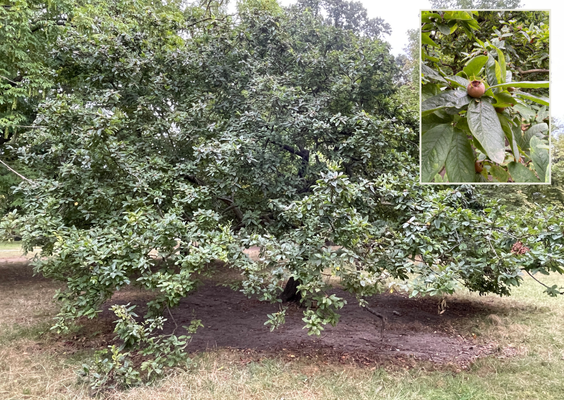
Medlar (Mespilus germanica) – This tree is an uncommon sight in London streets and parks, earning bronze status on treetalk (fewer than 200 reported in public places). Introduced by the Romans, the medlar was once a common sight in orchards. Its popularity slumped in the twentieth century, possibly in part due to its appearance, which earned it bawdy nicknames used by both Shakespeare and Chaucer (see for example Act 2 Scene 1 of Romeo and Juliet). The fruit also needs to be left until almost rotten to be rendered edible. In terms of wildlife benefits, they are one of the last fruit trees to flower in late May, providing a valuable pollen source for bees.
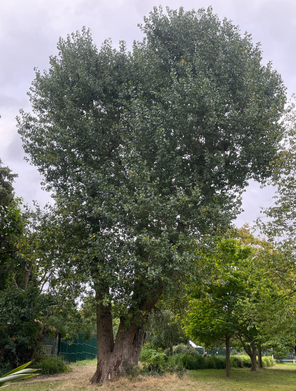
Black Poplar (Populus nigra) – The park hosts two of these beautiful trees, with the one by the scout hut being particularly striking, with its great height and three trunks. These trees are likely not the native subspecies betulifolia, which is the most endangered native timber tree in Britain. The native black poplar tree is dioecious, in other words, it occurs as male and female trees. Female trees produce large amounts of cottony seeds, considered messy by some. Thus there are only a few hundred female trees remaining in the UK, placing future generations of NBP under threat.
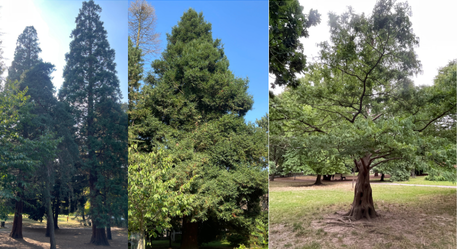
Redwoods (Giant Sequoiadendron giganteum, Coast Sequoia sempervirens and Dawn Metasequoia glyptostroboides) – These enormous conifers are natives of California, where they grow to spectacular heights.
They are well-adapted to the UK, where they benefit the environment by capturing tens of kilograms of carbon from the atmosphere every year. Due to climate change in their native range, the International Union for the Conservation of Nature regard Giant Redwood as ‘vulnerable’ and Coastal Redwood as ‘endangered’. The Dawn Redwood is a ‘living fossil’ which existed in the age of the dinosaurs, and was once thought to be extinct.
Caucasian Elm (Zelkova carpinifolia) –
Another treetalk bronze status tree, the Zelkova is notable both for its beauty and its resistance to Dutch Elm disease. This fungal disease, spread by bark beetles, destroyed most of the UK’s 30 million elms in the 1970s.

A final mention for the park’s Japanese Snowbell tree (Styrax japonicus). This unassuming tree bears a profusion of fragrant flowers in the early summer, providing a good source of pollen. This tree is a local rarity, with treetalk indicating that there are fewer than 10 in the parks and streets of London, thus earning gold status.
Emily Gardner
Newsletter Editor
*Unfortunately, the pond that is mentioned in several descriptions has long since dried up.
**This excellent resource provides data for all London boroughs, using data from the London Assembly, although it’s not clear how often the data is updated, and the map for Montpelier Park is definitely out of date.