
From the floral love potion that causes love at first sight, to the flower-strewn bank upon which the unwitting Fairy Queen Titania slumbers, plants are woven through Shakespeare’s masterpiece “A Midsummer Night’s Dream”*.
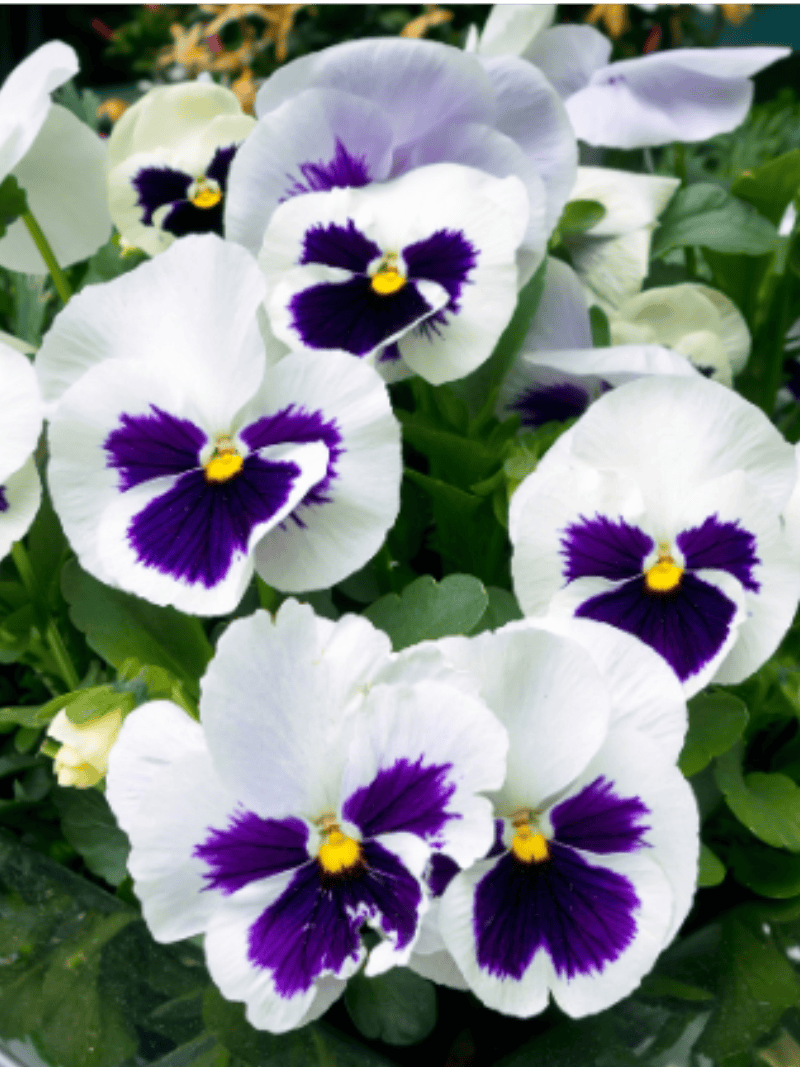
The little flower used in the potion that wreaks such havoc in the play is none other than the humble Pansy. As Fairy King Oberon recounts, a deflected shot from Cupid’s arrow “… It fell upon a little western flower, Before, milk-white, now purple with love’s wound, And maidens call it ‘love-in-idleness’.” (Act 2, Scene 1). The wounded Pansy thus carried both a purple heart and Cupid’s amorous powers. However, wild Pansies are not white with purple hearts, so maybe this was Shakespeare’s creative licence, although modern cultivars in this colour combination do exist.
Once Puck has collected the flower, Oberon plots to drop juice from the flower into Titania’s eyes whilst she sleeps. Her resting place is described by Oberon with the famous lines:
“I know a bank where the wild thyme blows, Where oxlips and the nodding violet grows, Quite over-canopied with luscious woodbine, With sweet musk-roses, and with eglantine: There sleeps Titania sometime of the night, Lull’d in these flowers with dances and delight;”
(Act 2, Scene 1)
The image is of an enchanted floral bower, a fitting resting place for a Fairy Queen. But have you ever thought about the plants that surrounded the sleeping Titania?
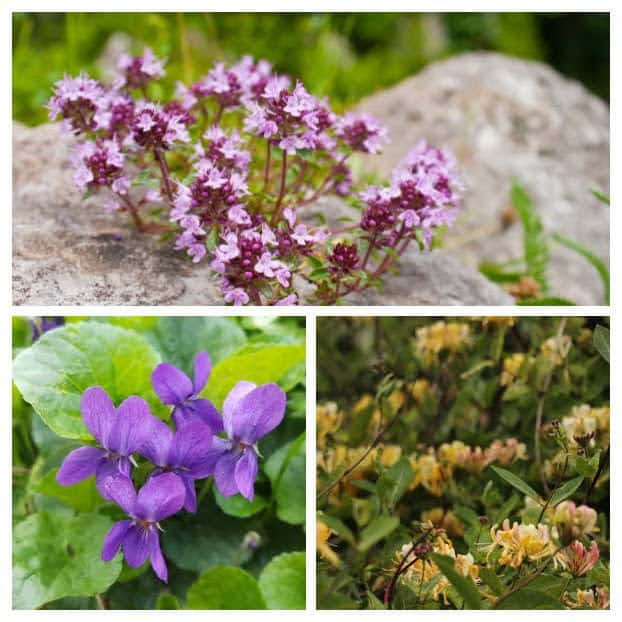
Clockwise from top:
Wild Thyme – probably Thymus polytrichus, which needs little introduction being a close relative of the culinary herb T. vulgaris.
Woodbine – we know this as Honeysuckle (Lonicera periclymenum) a vigorous twiner with highly scented flowers.
Violet – both Sweet Violet (Viola odorata) and Dog Violet (V. riviniata) are candidates here as both are woodland flowers, however for me Sweet Violet is the likelier, being scented.
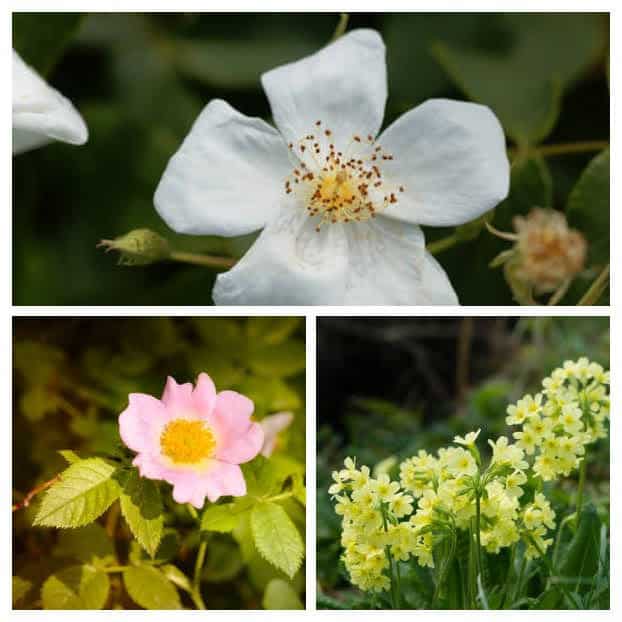
Clockwise from top:
Musk-rose – (Rosa moscata) grey-green foliage with single white flowers and a strong musk scent.
Oxlip – the giant Cowslip (Primula elatiour), a rarer woodland relative of the cowslip. Its flowers are paler yellow and grow in one-sided clusters.
Eglantine – (Rosa rubiginosa) also known as Sweet Briar. A rose before intensive breeding. Single pink flowers in a single flowering, followed by hips. Both flowers and leaves are highly scented.
Just imagine the intoxicating scent on a warm midsummer night!
Later in the play, after Titania wakes, and falls for “rude mechanical” Bottom, complete with ass’s head, she invites him to share these floral delights thus:
“Come, sit thee down upon this flowery bed, While I thy amiable cheeks do coy, And stick muskroses in thy sleek smooth head, And kiss thy fair large ears, my gentle joy”,
Act 4, Scene 1
and then uses a floral simile to describe their entwined sleep:
“Sleep thou, and I will wind thee in my arms. Fairies, begone, and be always away. So doth the woodbine the sweet honeysuckle gently entwist; the female ivy so enrings the barky fingers of the elm. O how I love thee, how I dote on thee!”
Happy floral midsummer dreams to you all!
Emily Gardner
EWG Newsletter Editor
* William Shakespeare: A Midsummer Night’s Dream [1595-1596], (2.1.249). If you don’t know the play, you can find a synopsis here.